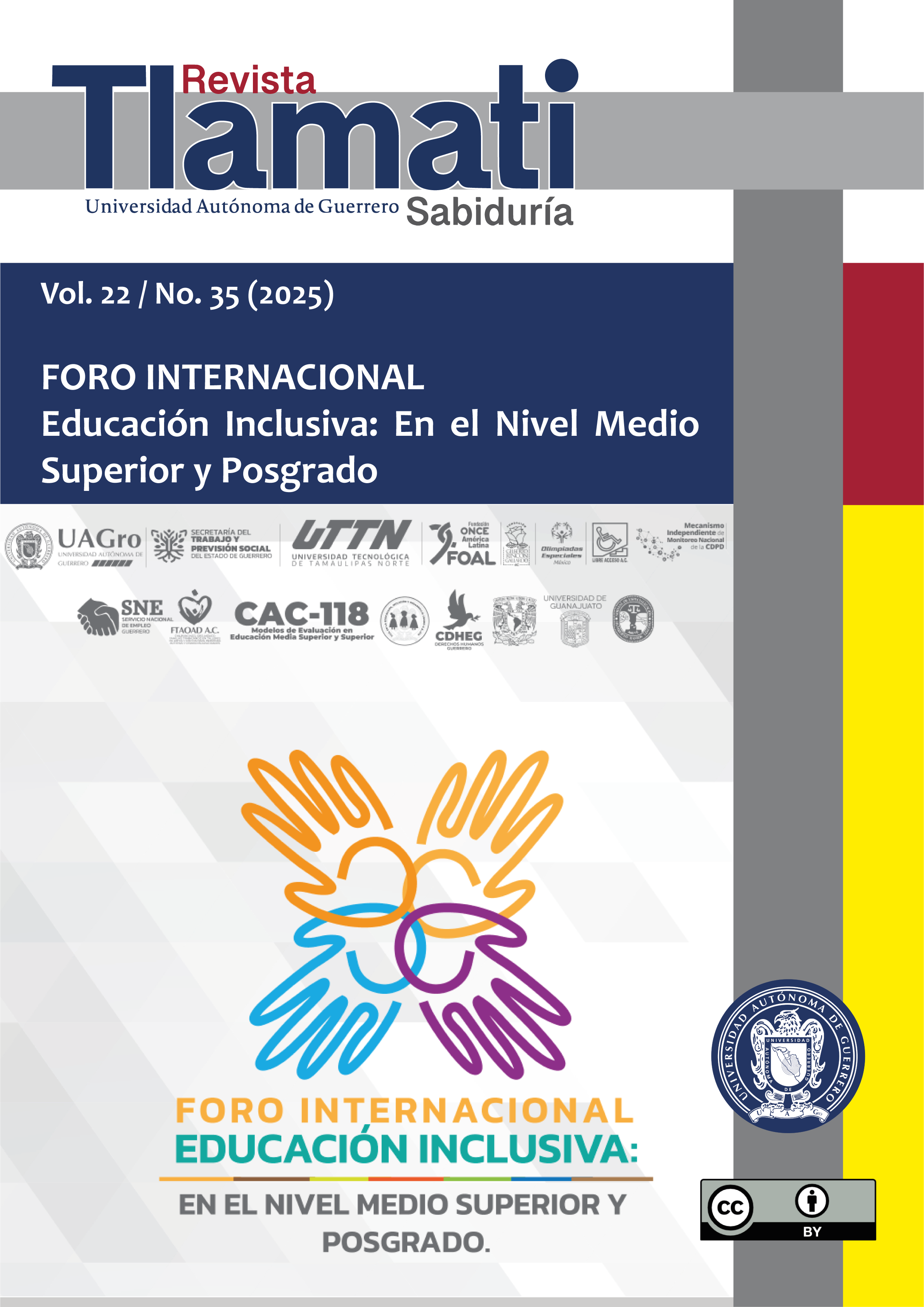
INTERNATIONAL FORUM Inclusive Education: At the Upper Secondary Level
Keywords:
inclusive education, disability, university, social inclusion, rights of people with disabilitiesAbstract
In the current context, Inclusive Education plays a fundamental role, serving as an integrating axis that offers children and young people the opportunity for access, quality, and equity without distinction or discrimination of any kind. Therefore, it guarantees universal access to education, integrating excluded social groups or those in situations of high vulnerability (origin, ability, gender, sexual orientation, religion, or socioeconomic status). Consequently, it is a basic task for the education sector to ensure equal opportunities for access to the knowledge and skills necessary to successfully integrate into society and the labor market under the best possible conditions, regardless of their circumstances. One of the main challenges for inclusive education lies not so much at the level of principles or vision, but rather in ensuring that strategies translate into an effective and profound change in institutional and pedagogical practices in schools and classrooms.
Therefore, the ICT in Education, Inclusion and Development CAs UAGro 214, as part of their activities, organized the International Forum on Inclusive Education in coordination with universities, public institutions and civil organizations interested in the topic. The purpose was to create spaces for dialogue, reflection and joint construction to address the challenges and problems of inclusive education at the Upper Secondary, Higher and Postgraduate levels, among the research community, educators, students and education professionals, to address latent, emerging and future situations and conditions through concrete proposals for accessibility, equity and quality education, from a perspective of human rights and personal development.
Downloads
References
Bellido, M. J. (2018). Dinámicas grupales. Liberate Líderes en Desarrollo Personal.
Docter, P., y Del Carmen, R. (Dirección). (2015). Intensa-Mente
Delors, J. (1996). La educación encierra un tesoro, informe a la UNESCO de la Comisión Internacional sobre la Educación para el Siglo XXI (compendio). UNESCO Biblioteca Digital, 46.
Goleman , D. (1995). La inteligencia emocional. Penguin Random House Grupo Editorial. Mares
Cisneros, M. (2023). Inteligencia emocional para docentes "Plenitud para enseñar".
INAD: https://inad.teachable.com/ Naciones Unidas (2018). La Agenda 2030 y los Objetivos de Desarrollo Sostenible: una oportunidad para América Latina y el Caribe (LC/G.2681- P/Rev.3),
Santiago. Núñez Cubero, L. (2008). Pedagogía emocional: una experiencia de formación en competencias emocionales en el contexto universitario. Secretariado de publicaciones Universidad de Sevilla, 65-80.
Brogna, P., & Rosales, D. (2003). Diagnóstico sobre el estado que guarda la atención a la temática de la
discapacidad en la Universidad Nacional Autónoma de México desde la perspectiva de derechos humanos.
Programa Universitario de los Derechos Humanos. Gaceta UNAM.
Comisión Nacional de los Derechos Humanos. (2023). Protocolo facultativo sobre discapacidad.
Instituto Nacional de Estadística y Geografía. (2020). Censo de Población y Vivienda 2020.
Ley número 464 de educación del estado libre y soberano de Guerrero; decreto número 805; Capítulo VIII denominado “Educación Inclusiva”; Periódico Oficial del Gobierno de Guerrero; viernes 14 de junio del 2024: Año CV Edición 48; Alcance VII.
Martín Lozano, I., & Sánchez-García, A. B. (Coords.). (2021). Una educación
inclusiva y de calidad: Ideas y estrategias para seguir avanzando.
Dykinson. Organización de las Naciones Unidas. (2006). Convención sobre
los derechos de las personas con discapacidad. Naciones Unidas.
Organización Mundial de la Salud. (2023). Disability and health.
Pérez, J. (2020). Educación inclusiva y políticas públicas en México. Editorial
Educación Abierta. Secretaría de Educación Pública. (2013). Reforma Educativa 2013.
Secretaría de Educación Pública. (2017). Modelo educativo: Equidad e inclusión.
Principales cifras del Sistema Educativo Nacional 2023-2024.
Universidad Autónoma de Guerrero. (2024). Anuario Estadístico UAGro. Ciclo Escolar 2023-2024.
Victoria Maldonado, J. A. (2013). El modelo social de la discapacidad:
una cuestión de derechos humanos. Revista de Derecho de la UNED, 12, 459–479.
J. W. (2013). Qualitative inquiry & research design: Choosing among five approaches (3.ª ed.). SAGE. Deci, E. L., & Ryan, R. M. (2008). Self- determination theory: A macrotheory of human motivation, development, and health. Canadian Psychology, 49(3),182–185.
Educación inclusiva: Qué es y qué no es. Narcea. Fuentes, M. (1998). Historia de la educación especial en México. SEP.
Hernández-Sampieri, R. (2014). Metodología de la investigación (6.ª ed.). McGraw-Hill. INEGI.
Instituto Nacional de Estadística y Geografía. Norwich, B. (2013). Addressing tensions and ilemmas in inclusive education.
Routledge. Oliver, M. (1990). The politics of disablement. Palgrave Macmillan. Organización de las Naciones Unidas para la Educación Ciencia y la Cultura. (2017). Guía para asegurar la inclusión y la equidad en la educación.
ORPISPCD. (2002). Programa Nacional para la Atención de las Personas con Discapacidad 2001–2006. Oficina de Representación para la Promoción e Integración Social de Personas con Discapacidad.
Pérez, M., Cruz, A., & Lázaro, P. (2021). La Lata: Colectivo de intervención cultural en discapacidad. UNAM. Red de Estudiantes y Egresados con Discapacidad de la UNAM. (2018).
Manifiesto REEDUNAM. UNAM. Saad, R., Díaz-Barriga, F., & Zacarías, J. (2022). Construyendo Puentes UNAM: Inclusión educativa para estudiantes con discapacidad intelectual. UNAM.
United Nations. (2006). Convention on the Rights of Persons with Disabilities.
Van Dijk, T. A. (2016). Discourse and power. Palgrave Macmillan.
World Medical Association. (2008). Declaration of Helsinki: Ethical principles for medical research involving human subjects.
Asociación Mexicana para la Atención de Personas con Discapacidad Visual (IAP)
Downloads
Published
Data Availability Statement
No
License
Copyright (c) 2026 Pérez López, Memije Alarcón, Zaragoza Martínez, Perla Elizabeth Ventura Ramos (Autor/a)

This work is licensed under a Creative Commons Attribution-NonCommercial-ShareAlike 4.0 International License.
This work is licensed under a Creative Commons Attribution-ShareAlike 4.0 International License.
Open Access Statement as defined by DOAJ
“Open Access” is a general term encompassing both Free and Open Access. For DOAJ, open access is only when digital content is freely available online and user rights and copyright terms are clearly defined.
All texts published by Tlamati—without exception—are distributed under the Creative Commons Attribution-ShareAlike 4.0 International License.
Authors may enter into separate, additional contractual agreements for the non-exclusive distribution of the version of the article published in Science and Philosophy ISSN: 2594-2204 (for example, including it in an institutional repository or publishing it in a book), provided they clearly indicate that the work was first published in Tlamati.
This is a human-readable summary of (and not a substitute for) the license.
You are free to:
Share
Read
Download
Translate
Copy
Distribute
Print
Search or link to the full text of the articles
Crawl them for indexing
Pass them as data into software or
Use them for any other lawful purpose, in any medium or format
License terms: https://creativecommons.org/licenses/by-sa/4.0/deed.es
You are free to:
Share — copy and redistribute the material in any medium or format for any purpose, even commercially.
Adapt — remix, transform, and build upon the material for any purpose, even commercially. The licensor cannot revoke these freedoms as long as you follow the license terms.
Under the following terms:
Attribution — You must give appropriate credit, provide a link to the license, and indicate if changes were made. You may do so in any reasonable manner, but not in any way that suggests the licensor endorses you or your use.
ShareAlike — If you remix, transform, or build upon the material, you must distribute your contributions under the same license as the original.
No additional restrictions — You may not apply legal terms or technological measures that legally restrict others from doing anything the license permits.