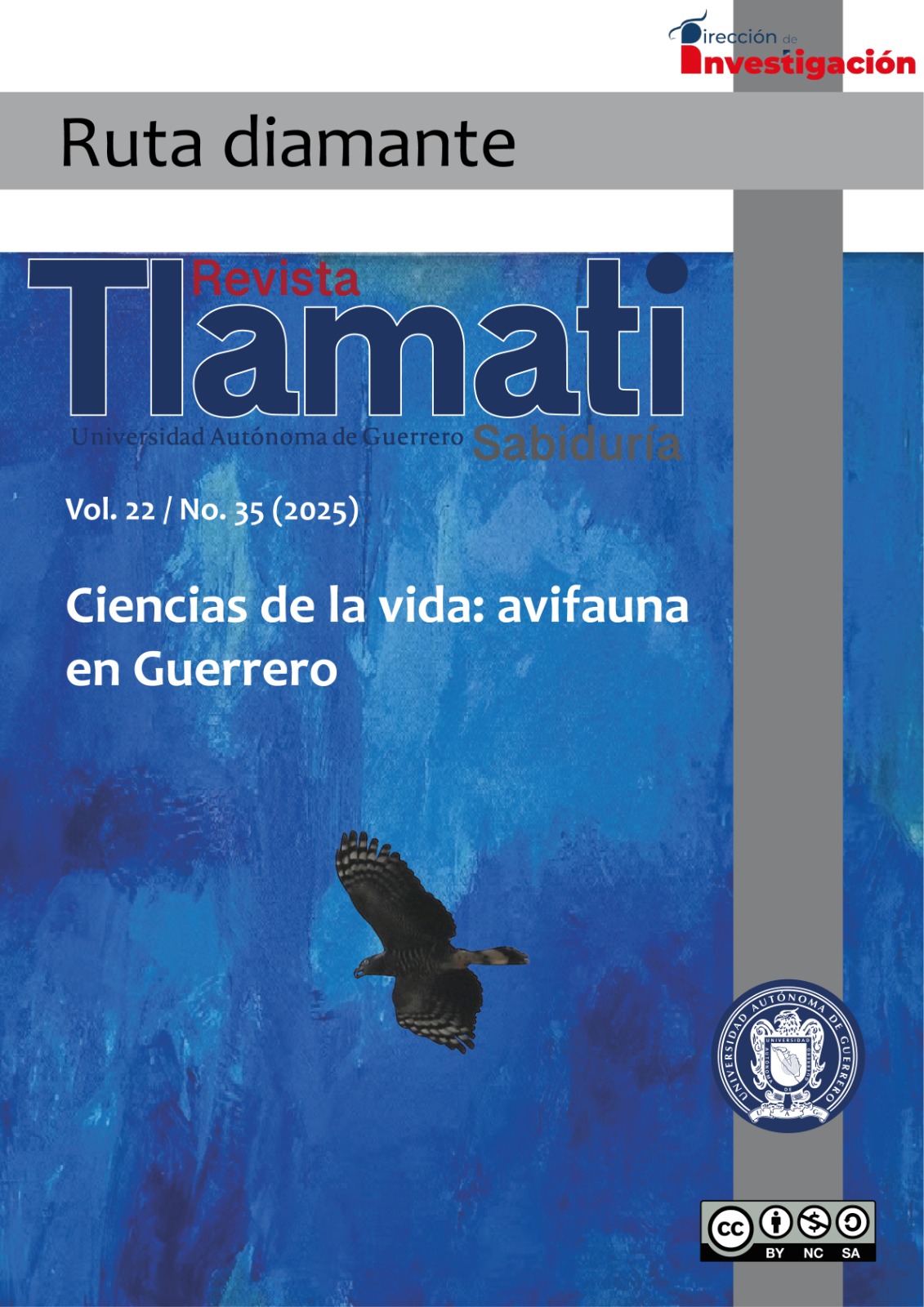
Expansion of the range of the Hook-billed Hawk (Chondrohierax uncinatus) in the state of Guerrero, Mexico
Keywords:
Accipitriformes, Avifauna of Guerrero, Risk status, Range expansion, RaptorsAbstract
We present three unpublished records of the Hook-billed Kite (Chondrohierax uncinatus) in the state of Guerrero, Mexico. This is a species for which there is limited information regarding its ecology, behavior, distribution, and conservation. The species is notable for its remarkable dietary specialization, as its diet consists mainly of arboreal snails. Two visual records were obtained in the locality of Jolotichán, municipality of San Luis Acatlán. The third record, supported by photographic evidence, was documented in the locality of Amojileca, municipality of Chilpancingo. This third sighting was made in an area adjacent to Omiltemi, a locality recognized as a biodiversity hotspot. The records of the Hook-billed Kite reported here provide support for an expansion of the species’ known distribution range. This range extends approximately 28 km east of Carrizal de Bravo, municipality of Eduardo Neri, and 20 km from the Valley of Tixtla, where it had been previously recorded. The records from Jolotichán, municipality of San Luis Acatlan, allow us to conclude that there is continuity in its distribution across the coastal plains between Guerrero and Oaxaca.
Downloads
References
Álvarez-Romero, J., Medellín, R.A., Oliveras de Ita, A., Gómez de Silva, H., Sánchez, O. (2008). Animales exóticos en México: una amenaza para la biodiversidad. CONABIO-INECOL-UNAM, SEMARNAT. México, D. F.
Audubon (2025). Gavilán pico de gancho. Audubon, https://www.audubon.org/es/guia-de-aves/ave/gavilan-pico-de-gancho
Berlanga, H., Gómez de Silva, H., Vargas-Canales, V.M., Rodríguez-Contreras, V., Sánchez-González, L.A., Ortega-Álvarez, R., Calderón-Parra, R. (2020). Aves de México: Lista actualizada de especies y nombres comunes. CONABIO, https://biodiversidad.gob.mx/media/1/especies/files/Lista_actualizada_aos_2021.pdf
BirdLife International (2025). Species factsheet: Hook-billed Kite Chondrohierax uncinatus, https://datazone.birdlife.org/species/factsheet/hook-billed-kite-chondrohierax-uncinatus
Blancas-Calva, E. (2020). Registros del zambullidor menor (Tachybaptus dominicus) en Omiltemi, Guerrero, México y la importancia de conservar la biodiversidad. Tlamati Sabiduría 11, 42-45, https://tlamati.uagro.mx/images/Archivos/Tlamati_Vol_11_2020/Blancas-Calva_
Chesser, R.T., Billerman, S.M., Burns, K.J., Cicero, C., Dunn, J.L., Hernández-Baños, B.E., Jiménez, A., Kratter, A.W., Mason, N.A., Rasmussen, P.C., Remsen Jr., J.V., Winker, K. (2023). Check-list of North American Birds (online).
American Ornithological Society, http://checklist.aou.org/taxa
Clark, W.S., Schmitt, N.J. (2017). Raptors of Mexico and Central America. Princeton University Press, 272 p, CONABIO (2017). Provincias Biogeográficas Mexicanas. Comisión Nacional para el Conocimiento y Uso de la Biodiversidad, http://geoportal.conabio.gob.mx/descargas/mapas/imagen/96/pbiogmx17gw
CONABIO (2025). Iniciativa para la Conservación de las Aves de América del Norte – México (NABCI – México). Comisión Nacional para el Conocimiento y Uso de la Biodiversidad, https://www.biodiversidad.gob.mx/especies/aves-de-mexico/nabci
Cruz-Romero, B., Gaspari, F.J., Rodríguez-Vagaría, A.M., Carrillo-González, F.M., Téllez-López, J. (2015). Análisis morfométrico de la cuenca hidrográfica del río Cuale, Jalisco, México. Investigación y Ciencia de la Universidad Autónoma de Aguascalientes, 64, 26-34.
Melo-de Dantas, S., Bustamante-Portes, C.E., Pinheiro, E., Kirwan, G.M. (2018). A review of flocking behavior by Hook-billed Kite, Chondrohierax uncinatus, in South America. Revista Brasileira de Ornitologia, 26, 9-11. del Val, E., Boege, K. (Coords.). (2016). Ecología y evolución de las interacciones bióticas. Fondo de Cultura Económica, UNAM.
eBird. (2025). eBird: An online database of bird distribution and abundance. Cornell Lab of Ornithology, https://ebird.org/species/hobkit
Ferguson-Lees, J., Christie, D.A. (2005). Raptors of the World. Princeton University Press, 320p.
GBIF (2025). Chondrohierax uncinatus. GBIF Occurrence. Global Biodiversity Information Facility, https://www.gbif.org/es/occurrence/search?offset=0&taxon_key=2480571
González-García, F., Gómez de Silva Garza, H. (2003). Especies endémicas: riqueza, patrones de distribución y retos para su conservación. In Gómez de Silva, H., Oliveras de Ita, A. 2003. Conservación de aves. Experiencias en México, 150-194.
CIPAMEX, CONABIO, National Fish and Wildlife Foundation.
Howell, S.N.G., Webb, S. (1995). A guide to the birds of Mexico and Northern Central America. Oxford University Press, A Guide To The Birds Of Mexico And Northern Central America | Oxford Academic
iNaturalista MX (2025). Gavilán Pico de Gancho (Chondrohierax uncinatus),
https://mexico.inaturalist.org/taxa/5329-Chondrohierax-uncinatus
Monterrubio-Rico, T.C., Cancino-Murillo, R., Lemus-Ortiz, E. (2022). Registro notable del gavilán pico de gancho Chondrohierax uncinatus depredando al caracol invasivo Rumina decollata en el lago Cuitzeo. Huitzil. Volumen 23, e-635.
Mouchard, A. (2019). Etimología de los nombres científicos de las aves de Argentina: Su significado y origen. Vázquez Mazzini Editores; UMAI Universidad Maimónides; AZARA Fundación de Historia Natural, etimologia-de-aves.pdf
Navarro-Sigüenza, A.G., Escalante, P. (1993). Aves. In Luna-Vega, I., Llorente-Bousquets, J. (Eds.), Historia natural del Parque Ecológico Estatal Omiltemi, Chilpancingo, Guerrero, México, 443-501. Facultad de Ciencias, Universidad Nacional Autónoma de México.
Historia natural del Parque Ecológico Estatal Omiltemi, Chilpancingo, Guerrero, México
Navarro-Sigüenza, A.G., Rebón-Gallardo, M.F., Gordillo-Martínez, A., Peterson, A.T., Berlanga-García, H., Sánchez-González, L.A. (2014). Biodiversidad de aves en México. Revista Mexicana de Biodiversidad, 85, 476-495, 10.7550/rmb.41882
Nelson, E.W. (1903). Descriptions of new birds from southern Mexico. Proceedings of the Biological Society of Washington, 16,151-160.
Peterson, R.T., Chalif, E.L. (1998). Guía de campo de las Aves de México. Diana. Ciudad de México. 473 p, https://publicaciones.iib.unam.mx/index.php/boletin/article/view/536/525
SEMARNAT (2010). NOM-059-SEMARNAT-2010: Protección ambiental–Especies nativas de México de flora y fauna silvestres–Categorías de riesgo y especificaciones para su inclusión, exclusión o cambio–Lista de especies en riesgo. Diario Oficial de la Federación, 30 de diciembre de 2010, Segunda Sección. México, D.F.
Sierra-Morales, P., Almazán-Núñez, R.C., Meléndez-Herrada A., García-Vega, C.S., Peñaloza-Montaño, M. A., Álvarez-Álvarez, E.A., Contreras-Rodríguez, A.I., Fuentes-Vega, A.S. (2019). Nuevos registros e información sobresaliente sobre la distribución de algunas aves del estado de Guerrero, México. Huitzil 20, e-520. 10.28947/hrmo.2019.20.2.421
Smith, T.B., Temple, S.A. (1982). Feeding habits and bill polymorphism in Hook-billed Kites. The Auk, 99, 197-207.
Villaseñor-Gómez, L., Manzano-Fisher, P. (Eds.) (2003). La educación ambiental y las aves: experiencias en México. In Gómez de Silva, H., Oliveras de Ita, A. Conservación de aves. Experiencias en México, 379-408. CIPAMEX, CONABIO, National Fish and Wildlife Foundation.
Published
Data Availability Statement
N/A
Issue
Section
Categories
License
Copyright (c) 2026 Epifanio Blancas-Calva, Marisol Castro-Torreblanca, Gabriel Antonio Cano-Nava (Autor/a)

This work is licensed under a Creative Commons Attribution-NonCommercial-ShareAlike 4.0 International License.
This work is licensed under a Creative Commons Attribution-ShareAlike 4.0 International License.
Open Access Statement as defined by DOAJ
“Open Access” is a general term encompassing both Free and Open Access. For DOAJ, open access is only when digital content is freely available online and user rights and copyright terms are clearly defined.
All texts published by Tlamati—without exception—are distributed under the Creative Commons Attribution-ShareAlike 4.0 International License.
Authors may enter into separate, additional contractual agreements for the non-exclusive distribution of the version of the article published in Science and Philosophy ISSN: 2594-2204 (for example, including it in an institutional repository or publishing it in a book), provided they clearly indicate that the work was first published in Tlamati.
This is a human-readable summary of (and not a substitute for) the license.
You are free to:
Share
Read
Download
Translate
Copy
Distribute
Print
Search or link to the full text of the articles
Crawl them for indexing
Pass them as data into software or
Use them for any other lawful purpose, in any medium or format
License terms: https://creativecommons.org/licenses/by-sa/4.0/deed.es
You are free to:
Share — copy and redistribute the material in any medium or format for any purpose, even commercially.
Adapt — remix, transform, and build upon the material for any purpose, even commercially. The licensor cannot revoke these freedoms as long as you follow the license terms.
Under the following terms:
Attribution — You must give appropriate credit, provide a link to the license, and indicate if changes were made. You may do so in any reasonable manner, but not in any way that suggests the licensor endorses you or your use.
ShareAlike — If you remix, transform, or build upon the material, you must distribute your contributions under the same license as the original.
No additional restrictions — You may not apply legal terms or technological measures that legally restrict others from doing anything the license permits.