
Smoothed Particle Hydrodynamics as a tool to mitigate structural damage due to fluid-structure interaction
Keywords:
smoothed particle hydrodynamics, computational fluid dynamics, fluid-solid interaction, hydrometeorological hazards, structureAbstract
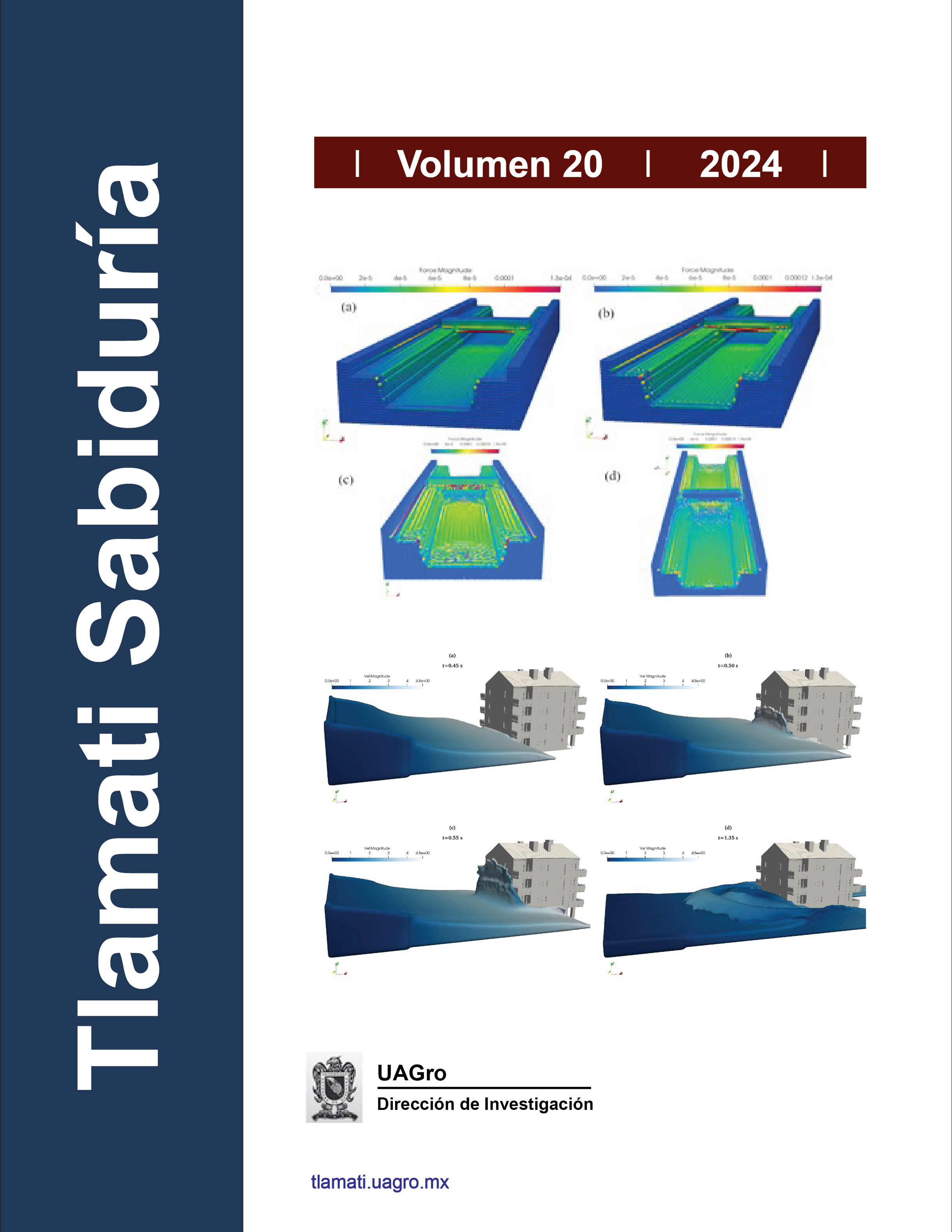
Computational simulations were performed using the smoothed particle hydrodynamics method to study the interaction between a fluid flow and a solid structure, resembling a bridge and a residential building. The aim was to demonstrate that the use of computational fluid dynamics technique is a valuable tool for evaluating the stresses experienced by the structure during fluid-structure interaction. Two arbitrary case studies were considered where velocity and stress fields were obtained to illustrate which areas experience greater stress than the rest of the infrastructure. This provided numerical-graphical technical support to recommend structural reinforcement or modification of the structural design, intending to mitigate potential structural damage primarily caused by fluid flow derived from hydrometeorological phenomena or tsunamis.
Downloads
References
Almonte-Pilco, N., De la Cruz-Vega, S. (2022). Evaluación y diseño de protección frente a la socavación hidráulica del puente Unocolla, Juliaca-Puno. Llamkasun, 3,74-78. https://doi.org/10.47797/llamkasun.v3i1.85
Becker, M., Teschner, M. (2007). Weakly compressible SPH for free surface flowss. In: Proceedings of the 2007 ACM SIGGRAPH/Europhysics Symposium on Computer Animation, San Diego, CA, USA, 2-4 August 2007; Metaxas, D., Popovic, J. (Eds.), 1-8. 2007_SCA_SPH.pdf
CENAPRED (2020). A 7 años del extraordinario fenómeno hidrometeorológico Ingrid y Manuel. Centro Nacional de Prevención de Desastres. https://www.gob.mx/cenapred/articulos/a-7-anos-del-extraordinario-fenomeno-hidrometeorologico-ingrid-y-manuel?idiom=es
Dehnen, W., Aly, H. (2012). Improving convergence in smoothed particle hydrodynamics simulations without pairing instability. Monthly Notices of the Royal Astronomical Society, 425, 1068-1082. https://doi.org/10.1111/j.1365-2966.2012.21439.x
Domínguez, J.M., Fourtakas, G., Altomare, C., Canelas, R.B., Tafuni, A., García-Feal, O., Martínez-Estévez, I., Mokos, A., Vacondio, R., Crespo, A J.C., Rogers, B.D., Stansby, P.K., Gómez-Gesteira, M. (2021). DualSPHysics: from fluid dynamics to multiphysics problems. Computational Particle Mechanics. https://doi.org/10.1007/s40571-021-00404-2
Gingold, R.A., Monaghan, J.J. (1977). Smoothed particle hydrodynamics: theory and application to non-spherical stars. Monthly Notices of the Royal Astronomical Society, 181, 375-389. https://doi.org/10.1093/mnras/181.3.375
Lucy, L.B. (1977). A numerical approach to the testing of the fission hypothesis. The Astronomical Journal, 82, 1013. https://doi.org/10.1086/112164
Majtan, E., Cunningham, L.S., Rogers, B.D. (2023). Numerical study on the structural response of a masonry arch bridge subject to flood flow and debris impact. Structures, 48, 782-797.
https://doi.org/10.1016/j.istruc.2022.12.100
Monaghan, J.J. (2005). Smoothed particle hydrodynamics. Reports on Progress in Physics, 68, 1703-1759.
https://doi.org/10.1088/0034-4885/68/8/r01 Pringgana, G., Cunningham, L.S., Rogers, B.D.
(2021). Influence of orientation and arrangement of structures on tsunami impact forces: Numerical investigation with smoothed particle hydrodynamics. Journal of Waterway, Port, Coastal and Ocean Engineering, 147. https://doi.org/10.1061/(asce)ww.1943-5460.0000629
Setyandito, O., Alexander Michael, R.D., Juliastuti, Andrew, J.P., Wijayanti, Y. (2020). The effect of bridge abutment shape variation toward flow velocity characteristic. IOP conference series. Earth and environmental science, 426, 012035. https://doi.org/10.1088/1755-1315/426/1/012035
SMN (s.f.). Información Histórica. Servicio Meteorológico Nacional. https://smn.conagua.gob.mx/es/ciclones-tropicales/informacion-historica
Wikipedia (2024). Computational fluid dynamics. Wikipe-dia, The Free Encyclopedia. https://en.wikipedia.org/w/index.php?title=Co mputational_fluid_dynamics&oldid=11975371 70
Yang, Y., Shao, J. (2020). Numerical simulation of fluid–structure interaction with SPH method. Journal of Engineering (Stevenage, England), 2020, 958-965.
Downloads
Published
Data Availability Statement
No
Issue
Section
Categories
License
Copyright (c) 2026 Lamberto Díaz-Damacillo (Autor/a)

This work is licensed under a Creative Commons Attribution 4.0 International License.
This work is licensed under a Creative Commons Attribution-ShareAlike 4.0 International License.
Open Access Statement as defined by DOAJ
“Open Access” is a general term encompassing both Free and Open Access. For DOAJ, open access is only when digital content is freely available online and user rights and copyright terms are clearly defined.
All texts published by Tlamati—without exception—are distributed under the Creative Commons Attribution-ShareAlike 4.0 International License.
Authors may enter into separate, additional contractual agreements for the non-exclusive distribution of the version of the article published in Science and Philosophy ISSN: 2594-2204 (for example, including it in an institutional repository or publishing it in a book), provided they clearly indicate that the work was first published in Tlamati.
This is a human-readable summary of (and not a substitute for) the license.
You are free to:
Share
Read
Download
Translate
Copy
Distribute
Print
Search or link to the full text of the articles
Crawl them for indexing
Pass them as data into software or
Use them for any other lawful purpose, in any medium or format
License terms: https://creativecommons.org/licenses/by-sa/4.0/deed.es
You are free to:
Share — copy and redistribute the material in any medium or format for any purpose, even commercially.
Adapt — remix, transform, and build upon the material for any purpose, even commercially. The licensor cannot revoke these freedoms as long as you follow the license terms.
Under the following terms:
Attribution — You must give appropriate credit, provide a link to the license, and indicate if changes were made. You may do so in any reasonable manner, but not in any way that suggests the licensor endorses you or your use.
ShareAlike — If you remix, transform, or build upon the material, you must distribute your contributions under the same license as the original.
No additional restrictions — You may not apply legal terms or technological measures that legally restrict others from doing anything the license permits.